Guide to Roulette Bets: Layout, Payouts, and Odds

Roulette remains one of the most popular casino games globally, captivating players with its fast-paced excitement and diverse betting opportunities.

Before placing your first bet, it is essential to understand the fundamental rules, and how they change, depending on the roulette variant you choose to play.

Understanding the Roulette Table: Layout and Variants

Every roulette game consists of two main components:

  • The wheel, which determines the winning outcome;
  • The betting layout (or felt), where players place their chips.

While the core gameplay is identical across versions, the wheel layout introduces a critical distinction:

  • European & French Roulette: Features a single green zero (0). The house edge is 2.70%;
  • American Roulette: Features both a single zero (0) and a double zero (00). This extra pocket increases the house edge to 5.26%.

Inside Bets vs. Outside Bets

Roulette wagers are divided into two primary categories based on their positioning on the betting table.

1. Inside Bets

These are placed directly on the numbers grid (0-36).

They cover fewer numbers, resulting in a lower probability of winning but significantly higher payouts.

  • Straight Up: A bet on a single number;
  • Split: A bet placed on the line between two adjacent numbers;
  • Street: Covers a horizontal row of three numbers;
  • Corner (Quad): Placed on the intersection of four numbers;
  • Six Line (Double Street): Covers two adjacent rows of three numbers (6 numbers total).

2. Outside Bets

These are placed on the boxes surrounding the numbers grid.

They cover large groups of numbers, offering a higher chance of winning but lower payouts (often paying 1:1 or 2:1).

  • Red or Black: Betting on the color of the winning pocket;
  • Odd or Even: Betting on whether the number will be odd or even;
  • Low or High: Betting on numbers 1–18 (Low) or 19–36 (High);
  • Dozens: Covering 12 numbers at once (1st, 2nd, or 3rd dozen);
  • Columns: Covering a full vertical column of 12 numbers.

Roulette Payouts and Odds Quick-Reference

The table below outlines the payouts and the statistical odds against winning for both American (38 pockets) and European (37 pockets) roulette.
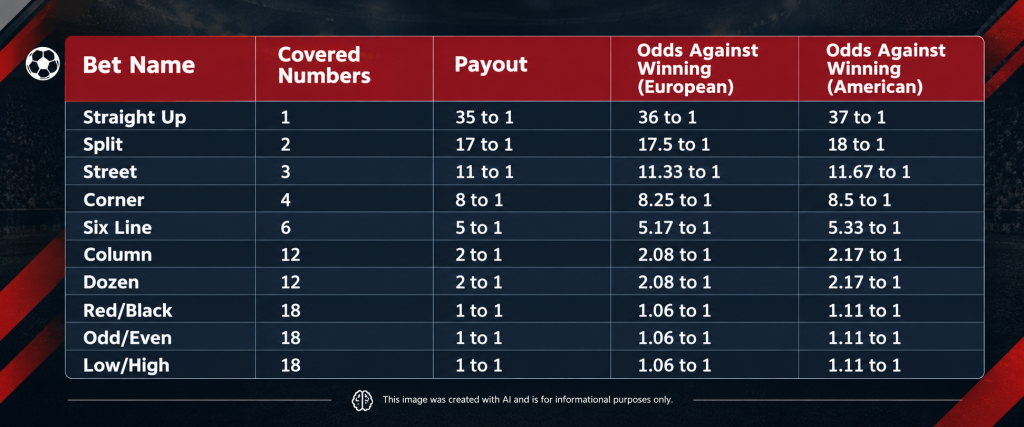
Covered Numbers

The column shows how many individual numbers you are betting on simultaneously with a single chip or wager.

  • If you place a Straight Up bet, your chip sits on exactly 1 specific number;
  • If you bet on Red/Black, you are covering 18 numbers all at once.

Payout

The column shows how much the casino pays you if your bet wins, using the “X to 1” format (where “1” represents your original bet, which is returned to you).

  • 35 to 1 Example (Straight Up): If you bet 1 unit on a single number and it hits, you win 35 units in profit, and the casino hands back your original 1 unit bet (you leave the table with 36 units total).
  • 1 to 1 Example (Red/Black): If you bet 10 units on Red and win, you get 10 units in profit plus your original 10 units back (totaling 20 units). This is commonly known as “even money”.

Odds Against Winning

This is the most critical mathematical part of the table.

It displays how many times you are statistically expected to lose for every 1 time you win.

The “X to 1” format here means: “You will lose X times for every 1 time you win.”

There are two separate columns because American Roulette features an extra pocket (the double zero – 00), which makes it harder for the player to win.

  • European Roulette Example (36 to 1 Odds on a Straight Up bet):
    Since a European wheel has 37 total pockets (numbers 1 to 36 plus a single green 0), there are 36 ways to lose and only 1 way to win. Therefore, the odds against you are 36 to 1.

(Notice that the casino only pays you 35 to 1, even though the true mathematical odds are 36 to 1. This slight difference is exactly how the casino generates its house edge and profit).

  • American Roulette Example (37 to 1 Odds on a Straight Up bet):
    Because this wheel has 38 total pockets (1 to 36, plus 0 and 00), there are now 37 ways to lose and only 1 way to win. Since the payout remains exactly the same (35 to 1), American Roulette is mathematically less favorable to the player.

Practical Summary

  • Top of the table (Inside Bets): You cover very few numbers. The odds against you are high (hard to hit), but when you do win, the payout is massive (up to 35x your wager).
  • Bottom of the table (Outside Bets): You cover nearly half the wheel (like Red/Black or Odd/Even). The odds are very close to 1 to 1 (nearly a 50% chance of winning), meaning you will win much more frequently, but your payout simply doubles your money.

Note: Special combination bets like the Basket (0, 1, 2) or Top Line (0, 00, 1, 2, 3) apply specifically to single or double-zero variants respectively.

3. Advanced Wagers: French / Call Bets

Unlike standard wagers placed on the grid layout, Call Bets (or Announced Bets) represent specific physical segments of the roulette wheel. They are traditionally found in European and French roulette. Here is exactly how they work, how many chips they require, and the numbers they cover:
  • Voisins du Zéro (Neighbors of Zero): This wager covers the 17 numbers closest to the green single zero on the wheel, spanning from 22 to 25. It requires 9 chips placed as a combination of splits, corners, and a trio (0, 2, 3).
  • Tiers du Cylindre (Third of the Wheel): This bet covers the 12 numbers directly opposite to the zero segment, running from 27 to 33. It requires 6 chips, all placed as splits (5/8, 10/11, 13/16, 23/24, 27/30, and 33/36).
  • Orphelins (Orphans): This covers the 8 remaining numbers not included in Voisins or Tiers (1, 6, 9, 14, 17, 20, 31, and 34). It requires 5 chips, consisting of 1 straight-up on number 1 and 4 splits.
  • Jeu Zéro (Zero Game): A smaller version of Voisins that covers the absolute closest neighbors to the zero pocket (12, 35, 3, 26, 0, 32, and 15). It costs 4 chips, placed as 1 straight-up on 26 and 3 splits.
  • Neighbor Bets: Most advanced layouts allow you to select a single number and bet on its “Neighbors” directly on the wheel wheel layout. A standard Neighbor Bet covers the chosen number plus the 2 numbers immediately to its left and the 2 numbers to its right, costing 5 chips in total.
  • Final Bets (Finales): Popular in traditional European casinos, these bets cover all numbers ending in a specific digit. For example, a bet on “Final 4” will automatically place straight-up wagers on 4, 14, 24, and 34, requiring 4 chips.

4. The House Edge and the Green Pockets

When playing roulette, understanding the mathematical advantage of the casino is crucial, and certain variations can heavily impact your odds.

Pro Tip: Avoid the American “Top Line” (Five-Number Bet)

When playing American Roulette, players can place a combination bet on five specific numbers: 0, 00, 1, 2, and 3. This is known as the Top Line or Basket bet. While it offers a 6:1 payout, it is mathematically the worst bet in the entire game. It spikes the house edge from the standard 5.26% up to a massive 7.89%. Smart players always avoid it.

How French Rules Lower the House Edge: La Partage & En Prison

If you play on a true French Roulette table, the punishing impact of the green zero pocket is heavily mitigated by two special rules applied to even-money outside bets (Red/Black, Odd/Even, High/Low):

  • La Partage (The Divide): If the ball lands on the green 0, you do not lose your entire outside wager. Instead, the bet is split 50/50. The casino keeps half, and hands the other half right back to you. This rule drops the house edge on even-money bets to a microscopic 1.35%.
  • En Prison (In Prison): Instead of giving you half your money back immediately, your wager is locked “in prison” on the table for the next spin. If your original bet wins on the subsequent spin, your chips are released, and you get your full original wager back without profit. If it loses, the casino takes it.

Frequently Asked Questions

Inside bets are placed directly on the numbers grid (0-36) covering fewer numbers, which leads to a lower winning probability but higher payouts. Conversely, Outside bets cover large groups of numbers on the surrounding boxes (like Red/Black or Dozens), offering higher winning chances with lower payouts.

The Straight Up bet on a single number yields the highest payout at 35 to 1. An “even money” or “1 to 1” payout means your profit equals your original wager (e.g., a $10 win returns $10 profit plus your $10 stake).

Advanced wagers on European/French tables covering specific physical wheel segments rather than table layout slots (e.g., Voisins du Zéro).

Roulette Articles
European Roulette: Rules, Odds, and How To Use Our Method

European Roulette: Rules, Odds, and How To Use Our Method

European Roulette stands out as the ultimate preference for seasoned enthusiasts and strategy experts alike. Understanding the mechanics, mathematical framework,…

Roulette Articles
D’Alembert System in Roulette

D’Alembert System in Roulette

The D’Alembert System is a traditional betting management method designed to help players structure their wagers at the roulette table….

Roulette Articles
How to Find the Best Online Casinos: The Essential Evaluation Guide

How to Find the Best Online Casinos: The Essential Evaluation Guide

With the rapid expansion of the digital gambling market, players now have thousands of online betting platforms at their disposal….

Roulette Articles
French Roulette Guide: Strategy, Rules and How to Use our Method

French Roulette Guide: Strategy, Rules and How to Use our Method

While the European and American variants dominate the floors of most casinos, French Roulette remains the undisputed queen of casino…