
European Roulette stands out as the ultimate preference for seasoned enthusiasts and strategy experts alike.
Understanding the mechanics, mathematical framework, and historical context of European Roulette is crucial before deploying any tactical betting system. Below, we break down how this specific wheel operates and how you can systematically apply a disciplined bankroll methodology to maximize your efficiency at the table.
The Origin and Architecture of European Roulette
While roulette’s earliest roots trace back to 17th-century France and the mathematician Blaise Pascal, the modern single-zero European Roulette layout was introduced in 1843 by French brothers François and Louis Blanc in Bad Homburg, Germany. They later brought this balanced layout to the iconic Casino de Monte Carlo, establishing it as the gold standard of European gambling.
The design is straightforward: the wheel features 37 pockets numbered from 0 to 36. The numbers alternate between red and black, with a single green pocket reserved for the number zero (0).
European Roulette vs. American Roulette: The House Edge
For a casual player, the structural difference between European and American variants might seem nominal. Mathematically, however, it represents the exact boundary between a highly fair game and an uphill battle against the house.
The critical differentiator lies within the green pockets:
The Statistical Breakdown
Adding the double-zero pocket significantly drives up the casino’s advantage while decreasing the player’s immediate equity.
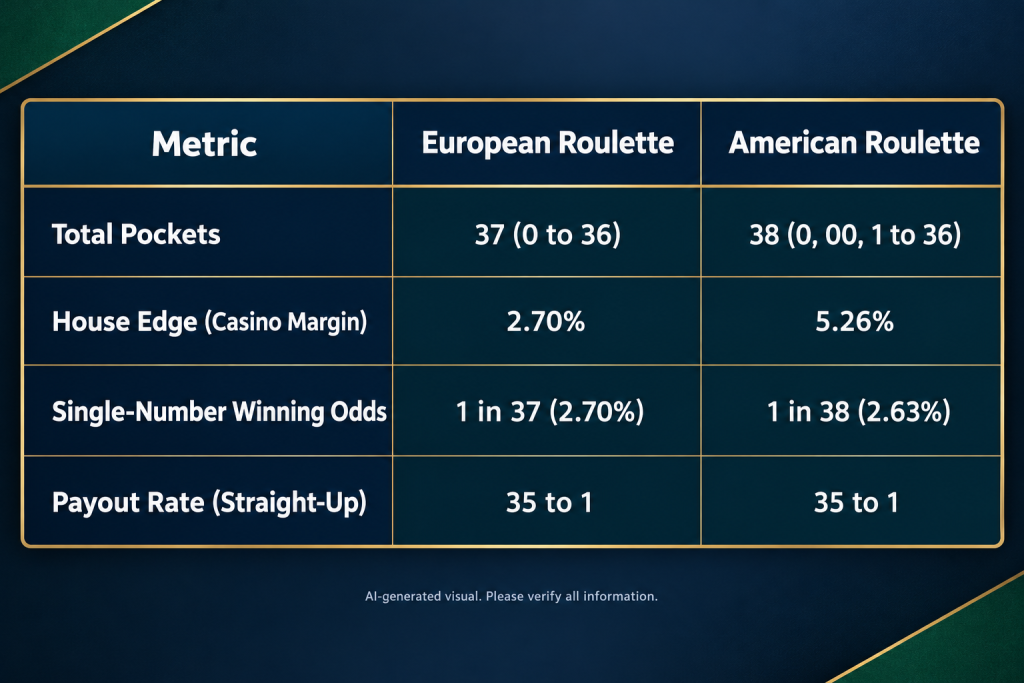
The Verdict: Whenever you have the luxury of choice in a live or digital casino environment, always opt for European Roulette. The 2.70% house edge provides your capital with vastly superior long-term sustainability compared to the punishing 5.26% edge of the American wheel.
How to Apply the Method Roulette System on European Wheels
Our mathematical approach to roulette relies entirely on mitigating risk exposure through strict behavioral rules and progressive bankroll structuralization. Because European Roulette features only one zero, it provides the optimal statistical environment to execute our structured betting framework without unnecessary volatility.
Here is how you step-by-step deploy our core method on a European layout:
Step 1: Establish Your Session Parameters
Before placing a single chip, you must calculate your Session Bankroll, Base Unit, and strict Profit/Loss Limits.
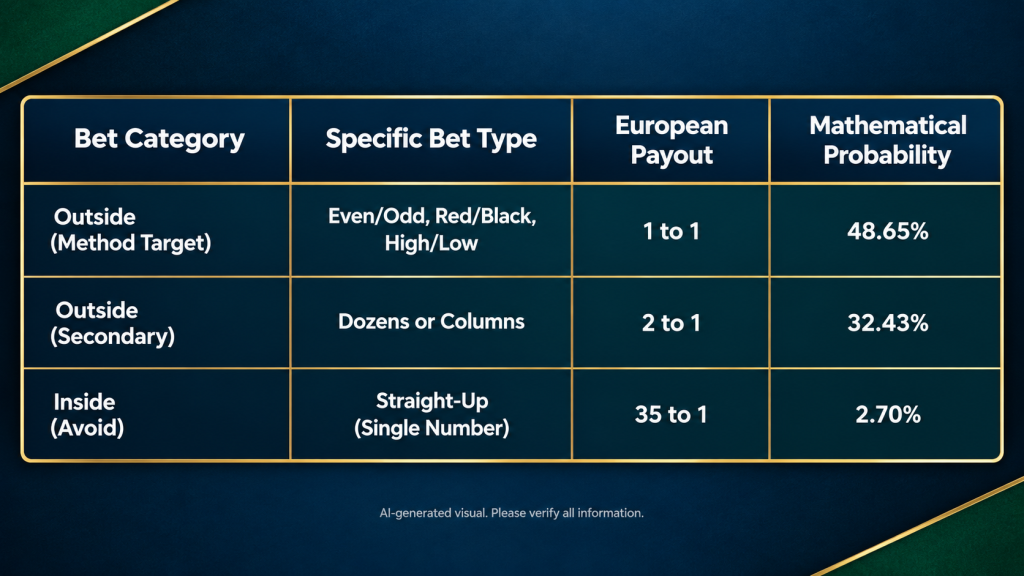
Step 2: Focus Solely on Even-Money Outside Bets
Our strategy is built upon the high-frequency hitting power of outside bets, which cover roughly 48.6% of the European table layout. Avoid volatile inside numbers. Instead, place your base unit on one of the following:
Step 3: Implement Controlled Recovery Progressions
Unlike high-risk systems like the Martingale, our methodology uses a smoother, controlled progression sequence—similar to a modified D’Alembert System—designed to prevent exponential losses:
Step 4: The Zero Accountancy Factor
In European Roulette, the green zero represents the house edge. If the ball lands on 0, all even-money bets lose. Our method treats a zero outcome strictly as a standard loss. You adjust your staking progression upward by one unit and move calmly to the next spin, relying on the single-zero mathematical model to smooth out recovery over the next series of distributions.
The mathematics behind European Roulette are immutable. No betting system, progressive framework, or behavioral rule can completely eliminate the 2.70% house edge built into the single-zero wheel.
Roulette remains, by its structural design, a game of pure variance and independent trials.
However, the true value of the Method Roulette System does not lie in manipulating mathematical certainty; it lies in shifting your execution from emotional guesswork to systematic risk management.
By restricting your gameplay strictly to high-frequency, even-money outside bets and absorbing losses through a smooth, controlled D’Alembert progression, you effectively smooth out volatility.
This structured approach preserves your capital, protects your bankroll from exponential spikes, and maximizes your long-term sustainability at the table.
Ultimately, success using this methodology is dictated entirely by your psychological control.
The mathematical model provides the blueprint, but your compliance with the pre-established win/loss boundaries dictates the outcome. Treat the table as a controlled environment, execute each progression mechanically, and always terminate the session the exact moment your parameters are met.
Watch it in action: Before committing real capital, visit our live Method Demonstration page to see exactly how these progressions balance out across multiple spins.
Choose a secure platform: If you are ready to practice disciplined bankroll control, ensure you play on audited, certified software by reviewing our curated list of Recommended Casinos.
Explore advanced variations: Want to lower the house edge even further? Discover how special table rules can cut the casino’s advantage in half by reading our comprehensive French Roulette Guide.
The D’Alembert System is a traditional betting management method designed to help players structure their wagers at the roulette table….
With the rapid expansion of the digital gambling market, players now have thousands of online betting platforms at their disposal….
While the European and American variants dominate the floors of most casinos, French Roulette remains the undisputed queen of casino…
American Roulette remains one of the most iconic and frequently played casino game variants worldwide. While its foundational rules date…


