
While the European and American variants dominate the floors of most casinos, French Roulette remains the undisputed queen of casino gaming.
As the original blueprint for modern roulette, it shares the same wheel appearance as the European version but introduces structural, mathematical safeguards that make it, without question, the most player-friendly game in the casino.
In this guide, we will break down the layout, explain the rules that cut the house edge in half, and demonstrate why our bankroll management method was specifically engineered to work only with this variant.
At first glance, French Roulette features the exact same 37-slot wheel (numbers 1 to 36, plus a single green zero) found in European Roulette.
However, its surface similarities hide massive structural advantages:
What truly turns French Roulette into a goldmine for strategic players are two unique rules applied exclusively to Even Money Bets (Red/Black, Even/Odd, High/Low):
If you place an even-money outside bet and the ball lands squarely on Zero (0), you do not lose your entire stake. Instead, 50% of your bet is immediately returned to your bankroll, while the casino keeps the other half.
A variation of the refund rule. When the Zero (0) hits, the dealer places a marker on your outside bet, locking it “in prison” for the next spin. If your original bet wins on the subsequent spin, you recover 100% of your original stake without any extra profit. If the zero hits twice in a row, the house outcome depends entirely on the specific casino’s rules.
Numbers do not lie. The introduction of these rules significantly alters the mathematical advantage the casino holds over your capital. Look at the direct comparison:
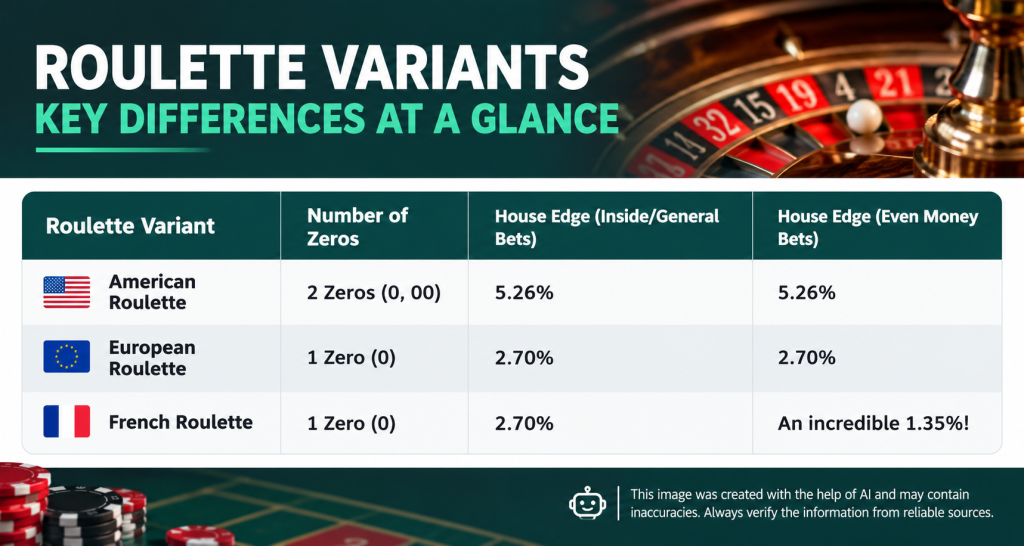
By playing French Roulette and focusing on even-money options, you face one of the lowest house advantages in the entire gambling industry, putting it on par with basic strategy Blackjack.
Exclusive: Why Our Method ONLY Works on French Roulette
Many of our users ask: “If the system is based on mathematical progressions, can’t I just use it on a European or American wheel?” The short answer is an absolute no. Our risk management and bankroll progression algorithm was surgically calibrated to exploit the specific mechanics of French Roulette. It will fail on other variants due to three distinct mathematical realities:
Every professional betting system (whether adapting a Martingale, D’Alembert, or Labouchere variant) suffers from the “Zero Strike”—the moment a zero disrupts a sequence of outside bets.
Our progression model operates on the strict premise that the house edge must remain below 1.5% for cycles to close in net profit before running into long-tail variance. At a 1.35% house edge, our system maintains long-term stability over hundreds of rounds. Exposing the exact same progression to the 2.70% edge of European roulette or the devastating 5.28% of American roulette leads to rapid, inevitable bankroll depletion.
Our method does not blindly guess colors. It utilizes French Call Bets to execute dynamic hedging maneuvers during high-volatility streaks. The precise geometric layout of the numbers on the physical French wheel allows us to block losses with a level of chip efficiency that the random layout of the American wheel cannot accommodate.
French Roulette shares the same 37-slot wheel (numbers 1 to 36 plus a single green zero) as European Roulette. However, it stands out due to its traditional layout labeled with French terms (Pair/Impair, Passe/Manque, Rouge/Noir) and, most importantly, its unique structural rules (La Partage and En Prison) that dramatically reduce the casino’s advantage.
French Roulette offers an exceptionally low house advantage. For even-money outside bets, the edge drops to 1.35%, compared to 2.70% in European Roulette and 5.28% in American Roulette.
While a zero normally causes a total loss, La Partage acts as an automated capital insurance policy. Recovering half your wager prevents escalation in the progression steps, keeping the system stable within table limits.
Call Bets cover specific physical wheel sectors like Voisins du Zéro or Tiers du Cylindre. The strategy uses these layouts for dynamic hedging during high-volatility streaks to manage chip efficiency.
The D’Alembert System is a traditional betting management method designed to help players structure their wagers at the roulette table….
With the rapid expansion of the digital gambling market, players now have thousands of online betting platforms at their disposal….
American Roulette remains one of the most iconic and frequently played casino game variants worldwide. While its foundational rules date…
The Labouchere System, also known as the Split Martingale or the Cancellation System, is one of the most celebrated betting…


