
The Labouchere System, also known as the Split Martingale or the Cancellation System, is one of the most celebrated betting progressions among roulette players worldwide.
Developed by Henry Labouchere, a prominent 19th-century British politician and writer, this system relies on strict mathematical logic rather than blind luck.
Designed exclusively for Even-Money Outside Bets (such as Red/Black, Odd/Even, or High/Low), the system aims to recover accumulated losses through a structured sequence of smaller wins.
However, while mathematically elegant, it carries hidden operational risks that every player must understand – just like every system.
The core philosophy of the Labouchere system is defining exactly how much profit you want to make before your session begins. Instead of risking flat amounts, you track a dynamic list of numbers on a piece of paper.
Decide on your target profit in betting units. Let’s say your goal is to win 15 units. You then split that total into a sequence of smaller positive numbers that sum up to 15. The exact distribution is entirely up to you. For example:
2 – 3 – 5 – 4 – 1
The value of your bet is always determined by adding the first and the last number of your active sequence. Using our baseline sequence:
The Ultimate Goal: The cycle is completed, and your target profit is locked in, the exact moment all numbers on your sheet are successfully crossed out.
Step-by-Step Simulation: How Fast the Sequence Grows
To visualize how the system behaves under pressure, let’s look at a realistic simulation showcasing an initial baseline sequence of 2 – 3 – 5 – 4 – 1 encountering a standard losing streak:
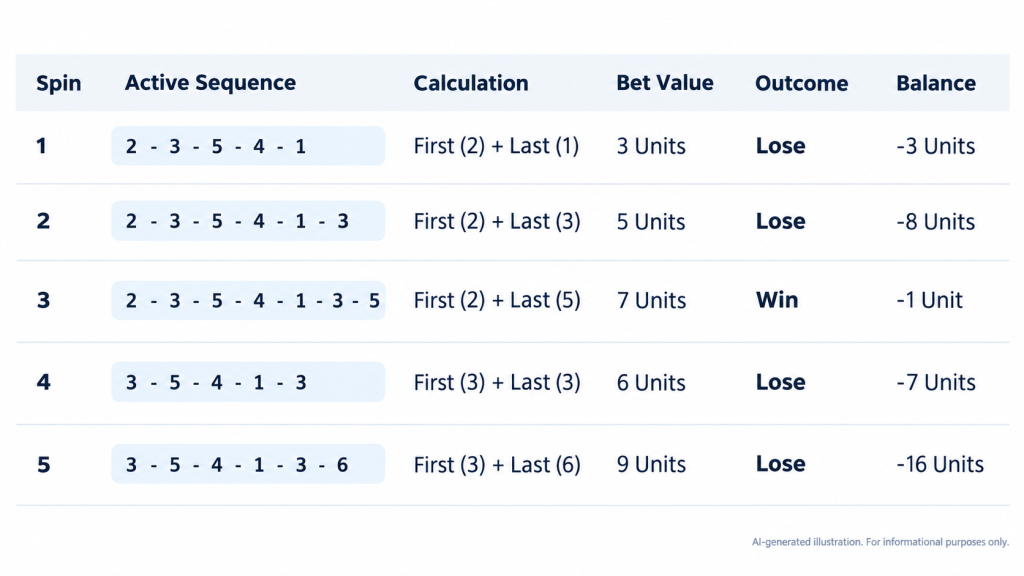
While amateur guides often praise the Labouchere system as a “safer” alternative to the aggressive Martingale system, mathematical reality dictates otherwise. Below are the definitive drawbacks you must consider before implementing it with real money:
While it is true that you do not double your stakes after every loss, a prolonged losing streak will cause your sequence to stretch rapidly. As losing amounts accumulate at the end of the line, the numbers get larger. A bad streak will cause your subsequent required bets to spike drastically, putting immense pressure on your bankroll.
Every roulette table has a strict maximum bet limit imposed by the casino. During a persistent bad variance cycle, the sum of your first and last sequence numbers can easily breach the table’s upper limit.
Once you hit this ceiling, the system completely breaks down, as you are legally barred from placing the required mathematical wager to recover your past losses.
To survive the wild swings of the Labouchere system, you need a substantial and deep bankroll. Running out of capital mid-cycle forces you to abandon the sequence entirely, locking in devastating losses.
No betting progression, including the Labouchere, can alter the fixed laws of mathematics. The casino maintains its native house edge (2.70% on European wheels and 5.26% on American wheels) on every isolated spin. The system merely redistributes your short-term variance—it does not give you an organic statistical advantage over the house.
Unlike flat betting, Labouchere demands constant logistical focus. You must record numbers, execute quick math, and cross items off under live casino pressure. A single calculation error caused by stress or distraction completely invalidates the system’s structural integrity.
It is a roulette betting system based on a mathematical sequence of numbers written down by the player. The objective is to help players win and recover losses without having to increase betting values exponentially
The method was created by Henry Labouchere, who was the finance minister of France between the seventeenth and eighteenth centuries.
This method applies only to outside bets. This means you must place your chips on bets that pay the equivalent of the bet amount (such as Red/Black or Even/Odd).
European Roulette stands out as the ultimate preference for seasoned enthusiasts and strategy experts alike. Understanding the mechanics, mathematical framework,…
The D’Alembert System is a traditional betting management method designed to help players structure their wagers at the roulette table….
With the rapid expansion of the digital gambling market, players now have thousands of online betting platforms at their disposal….
While the European and American variants dominate the floors of most casinos, French Roulette remains the undisputed queen of casino…


